Flax, known by its botanical nameLinum usitatissimum, is one of the oldest textile fibers used by humankind. For thousands of years, this plant has been a staple of civilizations thanks to its remarkable qualities: strength, breathability, durability, and natural comfort.
Today, in a world largely dominated by synthetic fibers, linen is experiencing a real resurgence in popularity. Consumers are looking for natural, sustainable, and comfortable fabrics. Linen meets these expectations perfectly.
But this fabric is about more than just its technical properties. It has a more emotional, almost intimate quality. Wearing linen often offers a unique experience: a sense of freshness, simplicity, and connection to nature.
In this article, we invite you to explore all aspects of linen: its origins, its textile properties, its environmental benefits, and the unique experience it offers in everyday life.
An elegant plant with azure-blue flowers
Before it becomes a fabric, flax is first and foremost a plant.
Flax grown for textile fibers is a slender, delicate plant that can growto between60 and 120 centimeters in height, depending on the variety and weather conditions. Its straight, delicate form gives it an elegant appearance in the fields.
But what strikes you most when you look at a field of blooming flax are itsdelicate, pale blue—almost azure—flowers. These very fragile flowers often last only a single day. Yet, for a few weeks, they transform the landscape into vast blue carpets that ripple in the breeze.
Yet beneath this delicate appearance lies a remarkable material.
For the true treasure of flax lieswithin its stem, where the textile fibers used to make yarns and fabrics develop.
The exceptional physical properties of flax fiber
Flax fiber has a combination of characteristics that make it a unique textile material.
Among its main properties:
· A long, strong fiber
Flax fibers can reachup to 90 cm in length after processing. This length makes it possible to produce strong, uniform yarns.
Linen is alsovery strong, which means that linen fabrics can last for many years when properly cared for.
· A fiber with little elasticity
Unlike some textile fibers, linen haslittle elasticity. This can sometimes result in more noticeable wrinkles, but it also contributes to its natural and authentic character.
· A slightly glossy surface
Linen fiber naturally hasa smooth, slightly lustrous surface, which gives linen fabrics an elegant, luminous appearance.
· Excellent moisture absorption
One of the great advantages of linen is its ability toabsorb moisture without leaving the skin feeling damp.
This property explains why linen clothing is particularly popular in hot climates.
A textile fiber that has been used for thousands of years
Flax is consideredone of the first textile fibers used by humans.
Evidence of flax use dates back thousands of years. In ancient civilizations, the fibers were already being spun and woven to produce clothing, household textiles, and ritual textiles.
Over time, linen has established itself as a premium fabric, synonymous with purity, durability, and quality.
Even with the advent of cotton and later synthetic fibers, linen has never disappeared. It has simply evolved and found its place in a variety of applications: clothing, home textiles, technical textiles, and even medical use.
The Benefits of Linen for Comfort and Health
Beyond its aesthetic appeal, linen hasproperties thatare highly beneficial for physical comfort.
Historically, these qualities have even led to its use in medical and hospital settings.
Until the 20th century, linen textiles were widely used in hospitals: sheets, bandages, patient gowns, and surgical drapes.
This use was due to several natural properties:
· Antibacterial properties
Linen hasnatural antibacterial properties, which help limit the growth of microorganisms.
· Hypoallergenic
Linen is asoft, skin-friendly fiberthat is generally well-tolerated, making it a suitable fabric for sensitive skin.
· Non-static
Unlike synthetic fibers, linendoes not generate static electricity, which makes it more comfortable to wear every day.
· Natural thermoregulation
Linen also has excellenttemperature-regulating properties
It keeps you cool when it's hot and warm when it's cold.
The environmental benefits of growing flax
One of the major advantages of linen is itsrelatively low environmental impactcompared to certain other textile fibers.
A crop that doesn't require much water
Fiber flax grown in Europegenerally does not require irrigation. Natural rainfall is sufficient in most regions.
Requires little fertilizer
Flax cultivation requireslittle fertilizerand relatively few chemical treatments.
A positive role in crop rotation
Flax is often included incrop rotation, which helps improve soil quality and reduce the incidence of certain crop diseases.
These characteristics make it a particularly attractive fiber for efforts to createmore sustainable textiles.
Flax cultivation in Europe
Today, global production of textile flax is largely dominated by Western Europe.
The main producing countries are:
- France, particularly in Normandy and the Hauts-de-France region
- Belgium
- the Netherlands
These three countries alone account forapproximately 75% of the world’s long-staple flax fiber production.
The mild, humid climate of these regions is particularly well-suited to the cultivation of fiber flax.
This local production also helps reduce the carbon footprint associated with transporting the fibers.
A deeply vibrant spirit
By definition, nature strives for perfect balance, the golden mean.
Everything in life is a matter of balance—not too much of this, nor too much of that. Linen possesses a profound vitality. It has a subtle, almost silent logic—the intelligence of something that doesn’t demand attention. It doesn’t seek to stand out; it remains understated and simply complements.
In a world saturated with plastics and synthetic fibers, linen can feel like a soothing presence. It is a simple, durable, and skin-friendly material.
A unique sensory experience
Beyond its technical properties, linen offers aunique sensory experience.
The feel of breathable fabric against the skin.
Natural coolness when it's hot.
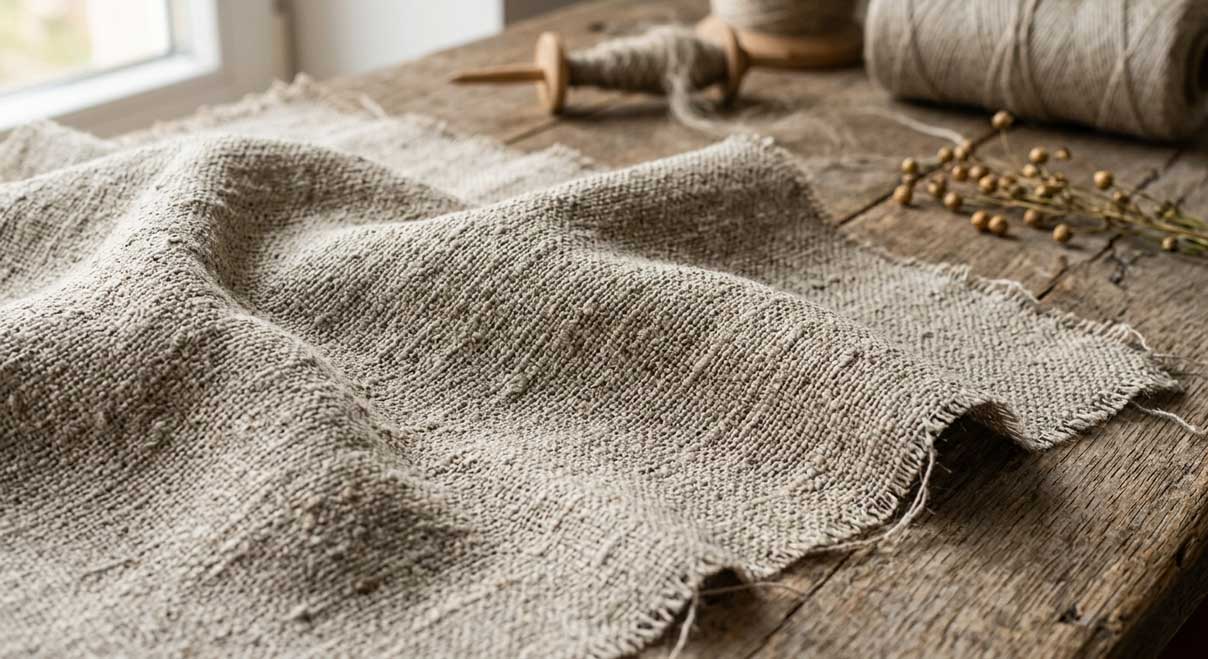
The slightly uneven texture that reflects its plant-based origin.
For many people, linen also brings back memories: a trip, a summer stroll, a shirt worn in warm weather, or a cool sheet on a peaceful night.
Some subjects fade into the background in everyday life.
Linen, on the other hand, is often noted for its simplicity.
Flax Today: A Fiber with a Bright Future
Given the environmental challenges and concerns regarding the sustainability of textiles, linen stands out asa particularly promising fiber for the future.
It has many advantages:
- natural and biodegradable fiber
- primarily European production
- relatively environmentally friendly farming
- high durability of the fabrics
More and more fashion and home textile brands are rediscovering the potential of linen and incorporating it into their collections.
There's a grain of truth to it
Synthetic fibers obviously have their uses and technical advantages. They are often lightweight, durable, and easy to care for.
But when it comes to experience, feel, and interaction with the material, natural fibers tell a different story.
Flax doesn't try to impress. It doesn't promise technological miracles.
It simply offers what it is: an authentic, breathable, sustainable fiber with deep roots in nature.
A subtle touch.
A living fiber.
Perhaps, deep down, there’sa grain of truth to it.