It was thanks to the fascinating book by Pascal Lamour, a doctor in pharmacy and a passionate scholar of ancient traditions, that I discovered a word that immediately struck a chord with me: the Nemeton, literally“the place where plants are prepared.”
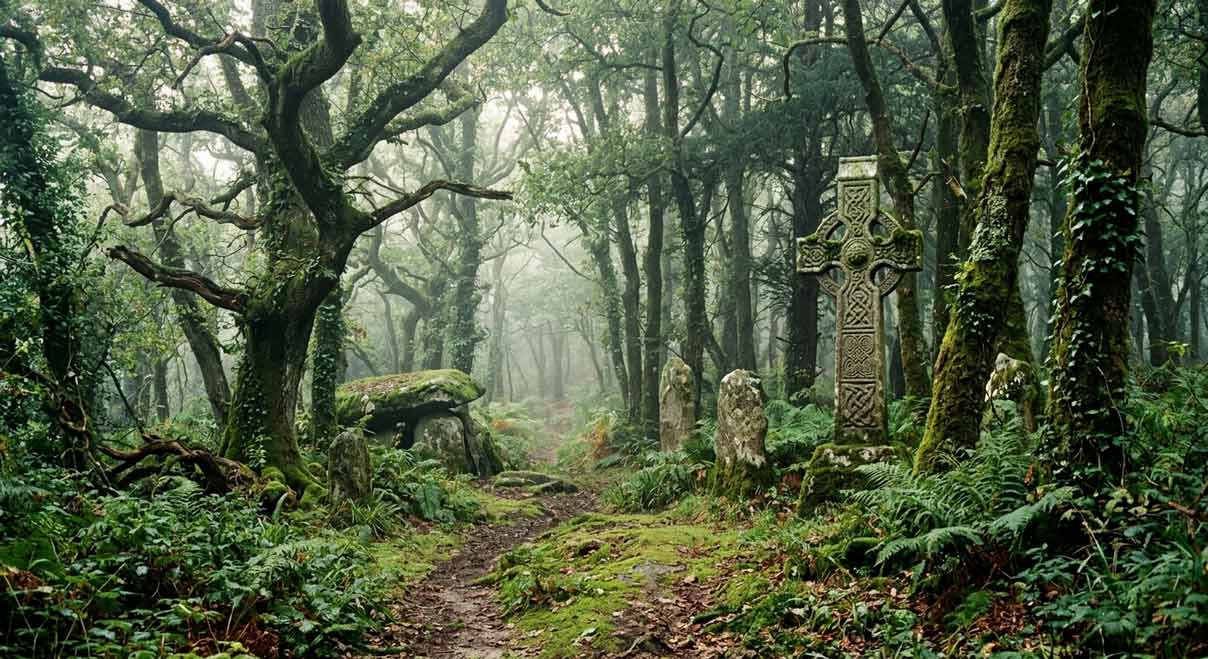
This idea resonated deeply with me. Celtic culture is part of my heritage. I was born where the land ends: in Finistère. In these landscapes of granite, wind, and ocean, nature is never merely a backdrop. It is a presence, a memory, and sometimes even a mystery.
Celtic culture is rooted in a worldview that is deeply connected to nature. Nature is viewed as living, sacred, and inhabited. For the Celts, human beings are not separate from the natural world: they are an integral part of it.
A spirituality rooted in nature
In Celtic tradition, nature plays a central role. Forests, rivers, springs, and certain landscapes were considered sacred.
Unlike other civilizations, the Celts did not necessarily build temples to honor their deities. Natural sites themselves became places of worship. Clearings, groves, and forests served as sanctuaries. It was in these places that theNemeton was found, a sacred site dedicated to rituals, the preparation of plants, and spiritual practices.
Trees also played a central role in this worldview. Each one had its own special symbolism:
- theoak, a symbol of strength and wisdom
- thebirch tree, associated with renewal and new beginnings
- the yew tree, associated with eternity and the transition between life and death
Observing the cycles of nature was an integral part of Celtic spirituality. The seasons set the pace for day-to-day life and gave rise to major celebrations.
Among the most important festivals were:
- Samhain, marking the beginning of the dark season
- Beltane, a celebration of the return of light and fertility
- Imbolc, a festival of renewal at the end of winter
These festivals were deeply rooted in the rhythms of the soil, the harvests, and the cycles of life.
Magic as an extension of nature
In Celtic culture, magic was not seen as something supernatural or extraordinary. It was simply part of the natural forces of the world.
The Celts believed in the existence of an invisible world, populated by spirits, deities, and fairy creatures. This world was not separate from ours: it coexisted with it.
Druids played a central role in this society. Serving as priests, scholars, healers, and advisors, they held considerable knowledge passed down orally from generation to generation.
Their role was multifaceted:
- perform religious rituals
- maintain the balance between the human world and the spiritual world
- observe the cycles of nature
- share knowledge
Celtic magic was based above all onan understanding of and respect for the forces of nature.
Plants at the Heart of Celtic Knowledge
In this culture, which was deeply rooted in nature, plants played a vital role.
They were used for healing, protection, and to support rituals. Druids and healers possessed a deep understanding of medicinal plants and their properties.
Some plants were particularly important.
Mistletoe, for example, was considered sacred. Picked according to specific rituals, it was associated with protection and healing.
Other plants were used for their medicinal or symbolic properties:
- some promoted healing
- others were related to fertility
- some served as protection
- still others were associated with wisdom or foresight
Knowledge of plants was passed down orally and was an integral part of druidic wisdom.
A worldview based on harmony
At its core, Celtic culture offers a worldview based on balance.
Human beings, nature, and the spiritual realm are not separate. Together, they form a living whole in which every element has its place.
Magic, plants, and landscapes are not separate from everyday life. They are at its very heart.
Perhaps that is why certain ideas from this tradition still resonate today. In a world often disconnected from nature, Celtic culture reminds us of something simple and essential:we are part of the living world.